
5 Signs Your Chakras May Need Rebalancing: Understand Your Energy Centers – Anu Nagpal
Have you ever felt emotionally overwhelmed, mentally restless, unusually tired, disconnected from yourself, or unable to find your usual sense of motivation and inner calm?
From a holistic and traditional chakra perspective, these experiences may encourage you to pay closer attention to your energy centers, emotional patterns, and overall sense of balance.
The chakra system is an ancient spiritual framework that describes seven primary energy centers along the body. Each chakra is traditionally associated with particular emotional, psychological, and spiritual themes. Practices such as meditation, Reiki, breathwork, visualization, and chakra balancing are commonly used by holistic practitioners to encourage relaxation, self-awareness, and a sense of energetic harmony.
If you are searching for chakra balancing in Delhi, chakra healing, or a Reiki healer in Delhi, Anu Nagpal offers personalised holistic sessions designed around individual wellness and spiritual goals.
This guide explains 5 common signs that may indicate it is time to pay more attention to your chakras, what the seven energy centers represent, and how chakra balancing can be incorporated into a holistic wellness routine.
Note: Chakra concepts belong to spiritual and traditional wellness systems and are not scientifically established medical diagnoses. Experiences such as persistent fatigue, sleep problems, anxiety, pain, or significant mood changes can have many causes. If symptoms concern you or persist, consult an appropriately qualified healthcare professional.
What Are Chakras?
The word chakra comes from Sanskrit and is commonly translated as “wheel” or “circle.”
In traditional Indian spiritual practices, chakras are described as subtle energy centers associated with different dimensions of human experience.
The commonly referenced seven main chakras are:
- Root Chakra – Muladhara
- Sacral Chakra – Svadhisthana
- Solar Plexus Chakra – Manipura
- Heart Chakra – Anahata
- Throat Chakra – Vishuddha
- Third Eye Chakra – Ajna
- Crown Chakra – Sahasrara
Each chakra is traditionally associated with particular qualities.
For example:
- The Root Chakra is associated with grounding and security.
- The Sacral Chakra is associated with emotions, creativity, and relationships.
- The Solar Plexus Chakra is associated with confidence and personal power.
- The Heart Chakra is associated with compassion and connection.
- The Throat Chakra is associated with communication and self-expression.
- The Third Eye Chakra is associated with intuition and inner awareness.
- The Crown Chakra is associated with spirituality and consciousness.
Chakra balancing practices aim to encourage awareness of these themes and create a greater sense of inner harmony.
What Does Chakra Imbalance Mean?
The idea of a “blocked” or “imbalanced” chakra comes from traditional energy-healing systems.
In this context, chakra imbalance does not mean that a medical organ is physically blocked.
Instead, practitioners may use the language of energy imbalance to describe experiences such as:
- Feeling emotionally stuck
- Difficulty expressing yourself
- Lack of motivation
- Feeling disconnected
- Excessive worry
- Difficulty relaxing
- Feeling ungrounded
- Losing touch with personal priorities
- Experiencing a lack of inner clarity
These experiences can have many different causes. Chakra practices can therefore be approached as a complementary spiritual or self-reflection practice, rather than a diagnostic system.
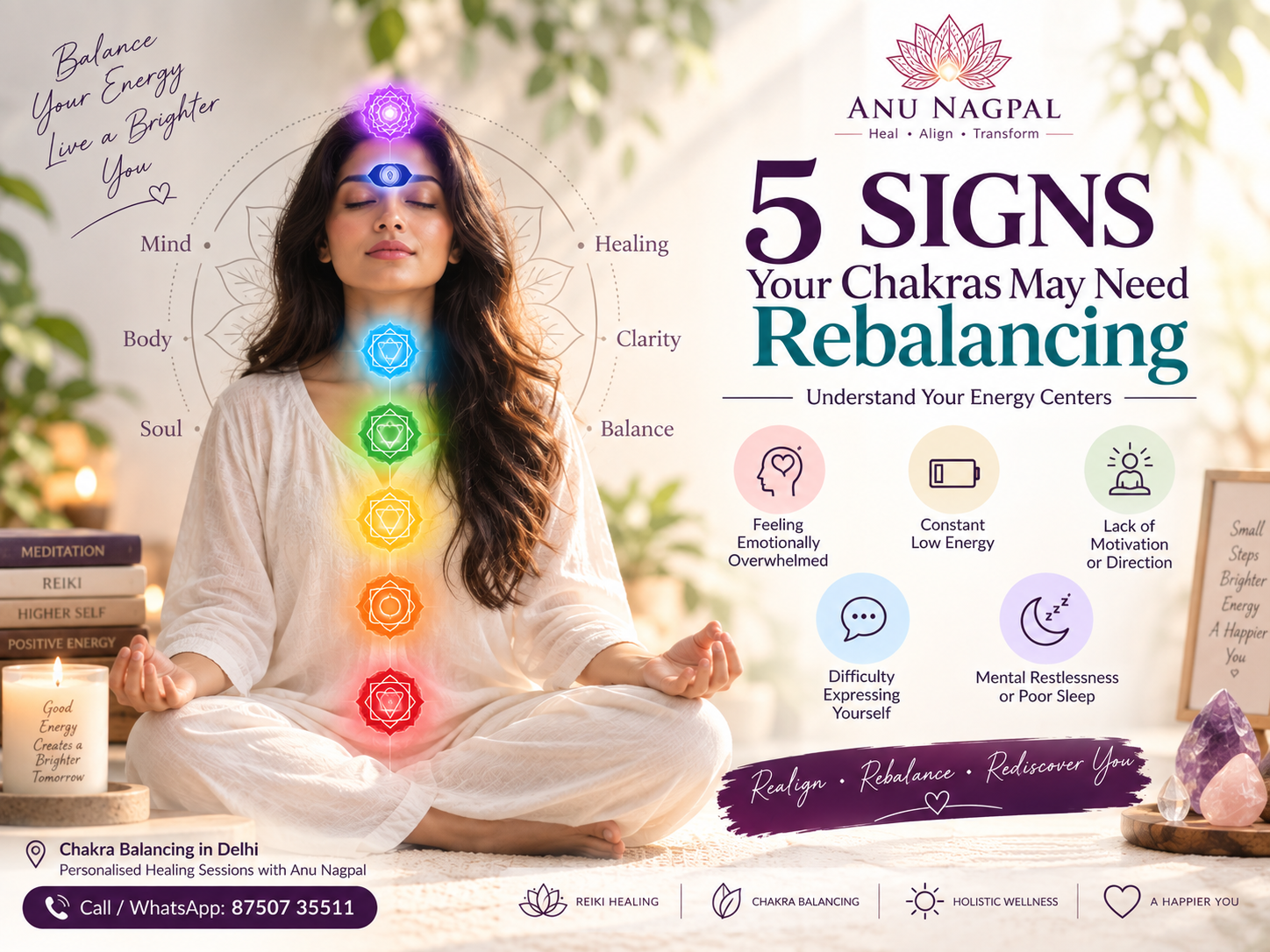
5 Signs Your Chakras May Need Rebalancing
Everyone experiences difficult days. Feeling tired, emotional, or unmotivated occasionally does not automatically mean that your chakras are “blocked.”
However, if you repeatedly notice certain emotional or lifestyle patterns, you may want to explore practices that encourage greater self-awareness and relaxation.
Here are five commonly discussed signs from a holistic chakra perspective.
1. You Feel Emotionally Overwhelmed
One of the most common reasons people explore chakra balancing is the feeling of being emotionally overloaded.
You may feel:
- Easily overwhelmed
- Emotionally drained
- Sensitive to situations around you
- Unable to switch off from stressful thoughts
- Stuck in repetitive emotional patterns
- Unable to process certain feelings comfortably
From a traditional chakra perspective, emotional themes are often explored through the Sacral Chakra and Heart Chakra.
The Sacral Chakra is traditionally associated with emotions, creativity, pleasure, and relationships, while the Heart Chakra is associated with compassion, love, connection, and emotional openness.
How Chakra Practices May Help
A chakra-balancing practice may involve:
- Guided meditation
- Breath awareness
- Visualization
- Reiki
- Mindfulness
- Journaling
- Relaxation techniques
The purpose is not to diagnose an emotional problem but to create a calm environment where you can observe your feelings and become more aware of your internal experience.
A Simple Reflection
Ask yourself:
“What emotion am I experiencing, and have I allowed myself enough time to acknowledge it?”
Sometimes simply recognizing an emotion without immediately reacting to it can create greater self-awareness.
2. You Constantly Feel Drained or Low on Energy
Another experience commonly discussed in holistic wellness is feeling energetically drained.
You may notice:
- Low motivation
- Difficulty maintaining your usual routine
- Feeling mentally exhausted
- Reduced enthusiasm
- A sense of heaviness
- Difficulty maintaining focus
From a chakra perspective, practitioners may explore several energy centers depending on the individual’s experience.
The Root Chakra is traditionally associated with grounding, stability, and security, while the Solar Plexus Chakra is associated with confidence, motivation, determination, and personal power.
Chakra Perspective on Energy
In traditional energy practices, the concept of energy is broader than physical energy alone.
Someone may feel physically capable but emotionally exhausted. Another person may have plenty of physical energy but feel mentally scattered or spiritually disconnected.
Chakra balancing encourages you to explore these different dimensions of your experience.
Try This
Sit quietly for five minutes.
Take slow, comfortable breaths and ask:
“Where am I spending most of my energy right now?”
You may discover that emotional stress, constant digital stimulation, unresolved conversations, or excessive commitments are consuming more energy than you realised.
3. You Feel Disconnected From Your Direction or Motivation
Have you ever thought:
“I know I want something to change, but I don’t know where to begin.”
This feeling can occur during career transitions, relationship changes, personal challenges, or periods of major uncertainty.
From a traditional chakra perspective, the Solar Plexus Chakra is associated with:
- Confidence
- Personal power
- Determination
- Willpower
- Motivation
- Taking action
When people explore chakra balancing, they may use these symbolic associations to reflect on their relationship with confidence and personal decision-making.
Questions for Self-Reflection
Consider asking yourself:
- What am I genuinely trying to achieve?
- Am I making decisions based on my values?
- What am I afraid of changing?
- Where do I need stronger boundaries?
- What small action can I take today?
Chakra work can become a structured form of self-reflection rather than simply an attempt to “fix” an energy center.
4. You Find It Difficult to Express Yourself
Communication is another important theme in the chakra system.
The Throat Chakra, or Vishuddha, is traditionally associated with:
- Communication
- Self-expression
- Speaking honestly
- Listening
- Authenticity
You may want to explore this area if you frequently feel that you:
- Hold your feelings inside
- Struggle to say what you really mean
- Avoid difficult conversations
- Find it difficult to establish boundaries
- Feel unheard
- Overthink what you want to say
Again, these experiences do not prove that a chakra is physically or medically “blocked.”
They can simply provide an interesting framework for self-reflection.
A Simple Practice
Take a journal and complete these sentences:
“What I really want to say is…”
“One boundary I need to communicate is…”
“Something I have been avoiding expressing is…”
You do not have to share the answers with anyone. The purpose is to become more aware of your own thoughts.
5. You Feel Mentally Restless or Disconnected From Inner Calm
Modern life can make it difficult to slow down.
Constant notifications, work responsibilities, social media, family commitments, and information overload can leave little time for stillness.
You may experience:
- Constant overthinking
- Difficulty relaxing
- Restlessness
- Difficulty concentrating
- Feeling mentally scattered
- Trouble creating quiet time for yourself
In traditional chakra systems, practitioners may explore the Third Eye Chakra and Crown Chakra when discussing intuition, awareness, meditation, and spiritual connection.
Creating Space for Stillness
You can begin with a simple five-minute practice:
- Sit comfortably.
- Close your eyes if comfortable.
- Take slow, natural breaths.
- Notice your thoughts without judging them.
- Bring your attention back to your breathing.
- Finish with one moment of gratitude.
This is not about forcing your mind to become completely empty.
The goal is simply to create a few moments of awareness.
Understanding the 7 Main Chakras
To understand chakra balancing, it helps to know what each traditional energy center represents.
1. Root Chakra – Muladhara
Location traditionally associated with: Base of the spine
Traditional themes:
- Grounding
- Stability
- Security
- Belonging
- Physical existence
- Connection with everyday life
When exploring Root Chakra themes, you might reflect on whether you feel grounded and secure in your daily life.
Reflection Question
“What helps me feel safe, stable, and grounded?”
2. Sacral Chakra – Svadhisthana
Location traditionally associated with: Lower abdomen
Traditional themes:
- Emotions
- Creativity
- Pleasure
- Relationships
- Flexibility
- Emotional expression
This chakra is often explored when discussing emotional flow and creativity.
Reflection Question
“Am I allowing myself to experience emotions and creativity without unnecessary judgment?”
3. Solar Plexus Chakra – Manipura
Location traditionally associated with: Upper abdomen
Traditional themes:
- Confidence
- Personal power
- Motivation
- Willpower
- Self-esteem
- Action
Reflection Question
“Where can I take greater responsibility for my choices?”
4. Heart Chakra – Anahata
Location traditionally associated with: Center of the chest
Traditional themes:
- Compassion
- Love
- Connection
- Forgiveness
- Empathy
- Emotional openness
Reflection Question
“Am I giving myself the same compassion that I offer other people?”
5. Throat Chakra – Vishuddha
Location traditionally associated with: Throat
Traditional themes:
- Communication
- Truth
- Self-expression
- Listening
- Authenticity
Reflection Question
“Am I expressing my needs honestly and respectfully?”
6. Third Eye Chakra – Ajna
Location traditionally associated with: Center of the forehead
Traditional themes:
- Intuition
- Inner awareness
- Perception
- Reflection
- Mental clarity
Reflection Question
“Am I giving myself enough quiet time to understand what I truly think and feel?”
7. Crown Chakra – Sahasrara
Location traditionally associated with: Top of the head
Traditional themes:
- Spirituality
- Consciousness
- Connection
- Meaning
- Contemplation
Reflection Question
“What gives my life a deeper sense of meaning?”
What Is Chakra Balancing?
Chakra balancing is a holistic spiritual practice intended to encourage awareness and a sense of harmony within the traditional chakra system.
Different practitioners may use different approaches, including:
- Reiki
- Meditation
- Breathwork
- Visualization
- Sound-based practices
- Guided relaxation
- Energy-healing techniques
- Mindfulness
- Spiritual reflection
A session may focus on one particular chakra or explore the seven main energy centers as a whole.
Reiki and Chakra Balancing
Reiki and chakra balancing are often used together in holistic wellness practices.
Reiki is a Japanese-origin spiritual practice commonly associated with relaxation, meditation, and hands-on or hands-near energy work.
During a Reiki-based chakra session, a practitioner may guide the client through relaxation while focusing attention on different energy centers.
The experience can vary from person to person.
Some people may describe:
- Deep relaxation
- Warmth
- Calmness
- Emotional release
- Increased self-awareness
- A sense of peacefulness
Others may simply enjoy having dedicated quiet time away from their normal routine.
Individual experiences should not be interpreted as proof of a medical effect.
Can You Balance Your Chakras at Home?
Yes, many people incorporate simple chakra-focused practices into their personal wellness routine.
You can explore:
Meditation
Spend 5–10 minutes focusing on breathing and gradually bringing awareness through the body.
Visualization
Visualize the traditional color associated with each chakra while focusing on the qualities symbolically connected with it.
Breathwork
Slow, comfortable breathing can help create a relaxation routine.
Journaling
Write about emotions, relationships, goals, fears, and personal boundaries.
Mindful Movement
Yoga, stretching, walking, or other comfortable forms of movement can be incorporated into a wellness routine.
Reiki
If you are interested in Reiki, you can explore sessions with an experienced practitioner or learn Reiki practices through appropriate training.
When Should You Consider Professional Chakra Balancing?
You may consider a professional session if you want:
- Structured guidance
- A dedicated relaxation experience
- Help developing a meditation routine
- Support with spiritual self-reflection
- A personalised chakra-focused practice
- To combine Reiki and chakra work
- To explore holistic wellness practices
A professional session should feel supportive rather than frightening or pressuring.
A responsible practitioner should not tell you that you have a serious disease because of a “blocked chakra,” nor should they discourage you from seeking appropriate medical care.
Chakra Balancing in Delhi with Anu Nagpal
If you are searching for chakra balancing in Delhi, Anu Nagpal offers personalised holistic sessions for individuals interested in energy work, Reiki, meditation, and spiritual wellness.
With extensive experience in holistic healing, Anu Nagpal takes a personalised approach rather than treating every client in exactly the same way.
A session may incorporate practices such as:
- Chakra balancing
- Reiki
- Meditation
- Energy healing
- Spiritual guidance
- Relaxation techniques
- Personal reflection
The goal is to create a calm environment where you can focus on your own wellbeing and inner awareness.
Why Choose Anu Nagpal for Chakra Balancing?
When choosing a holistic practitioner, it is important to find someone whose approach aligns with your expectations.
Anu Nagpal’s approach focuses on:
Personalised Sessions
Every person comes with different experiences, questions, and wellness goals.
Holistic Perspective
Chakra work can be explored alongside meditation, Reiki, mindfulness, and other wellness practices.
Compassionate Guidance
A comfortable and non-judgmental environment can make it easier to explore personal emotions and experiences.
Spiritual Self-Awareness
The practice can encourage you to reflect on your thoughts, emotions, relationships, values, and personal direction.
Experienced Holistic Practitioner
Anu Nagpal brings extensive experience in holistic healing and spiritual wellness practices.
What Happens During a Chakra Balancing Session?
A session may vary depending on the practitioner and your individual needs.
A typical experience may include:
Step 1: Initial Conversation
You discuss your current concerns, expectations, and goals.
Step 2: Relaxation
The session may begin with breathing or meditation to help you settle into a relaxed state.
Step 3: Chakra Awareness
Attention may be directed toward the traditional seven energy centers.
Step 4: Energy-Healing Practice
Depending on the session, Reiki or another holistic technique may be incorporated.
Step 5: Reflection
You may discuss your experience and identify areas for continued self-care.
Step 6: Personal Wellness Suggestions
You may receive suggestions involving meditation, journaling, relaxation, or other complementary practices.
How Often Should You Have Chakra Balancing?
There is no universally established schedule for chakra balancing.
Some people explore a single session when they want relaxation or a new perspective. Others prefer occasional sessions as part of a broader spiritual or wellness routine.
The appropriate frequency depends on:
- Your personal goals
- Your schedule
- Your experience
- Your interest in spiritual practices
- Your preferred wellness routine
Avoid feeling that you must book repeated sessions indefinitely.
Holistic practices should support your independence and self-awareness rather than create dependency.
Chakra Balancing vs Reiki: What’s the Difference?
Although they are often combined, Reiki and chakra balancing are not exactly the same practice.
| Reiki | Chakra Balancing |
|---|---|
| Japanese-origin spiritual practice | Based on traditional chakra concepts |
| Often focused on relaxation and energy work | Focuses specifically on traditional energy centers |
| May be practiced hands-on or hands-near | May involve meditation, visualization, Reiki, sound, or other practices |
| Can be used as a standalone practice | Often combined with other holistic techniques |
| Individual experiences vary | Individual experiences vary |
Some practitioners, including Anu Nagpal, may integrate Reiki and chakra-focused practices into a holistic session.
7 Chakra Colors and Their Traditional Associations
The chakra system is often represented using seven colors:
| Chakra | Traditional Color | Commonly Associated Themes |
|---|---|---|
| Root | Red | Grounding & stability |
| Sacral | Orange | Creativity & emotions |
| Solar Plexus | Yellow | Confidence & personal power |
| Heart | Green | Compassion & connection |
| Throat | Blue | Communication & expression |
| Third Eye | Indigo | Intuition & awareness |
| Crown | Violet/White | Spirituality & consciousness |
These color associations are part of modern representations of the chakra system and should be understood within their spiritual and cultural context.
Simple 7-Chakra Daily Awareness Practice
You do not need a complicated routine to begin exploring chakra awareness.
Try this simple practice for 5–10 minutes.
Step 1 – Ground Yourself
Take several comfortable breaths and bring your attention to your body.
Step 2 – Root
Think about stability and grounding.
“What helps me feel secure?”
Step 3 – Sacral
Bring attention to emotions and creativity.
“What am I feeling today?”
Step 4 – Solar Plexus
Reflect on confidence and action.
“What is one thing I can take responsibility for today?”
Step 5 – Heart
Bring awareness to compassion.
“Where can I show myself or someone else more kindness?”
Step 6 – Throat
Reflect on communication.
“What do I need to express honestly?”
Step 7 – Third Eye
Spend a moment in quiet observation.
“What am I noticing without immediately judging it?”
Step 8 – Crown
Reflect on meaning and connection.
“What brings meaning to my life?”
Finish by taking a few slow breaths.
Frequently Asked Questions About Chakra Rebalancing
What are the signs that your chakras need balancing?
From a traditional chakra perspective, people may associate emotional overwhelm, feeling ungrounded, low motivation, difficulty expressing themselves, and mental restlessness with areas they wish to explore through chakra-focused practices. These experiences are not medical indicators of a chakra imbalance.
How do I know if my chakras are blocked?
There is no medically established test for a “blocked chakra.” Within holistic traditions, practitioners may explore recurring emotional or spiritual themes through meditation, Reiki, visualization, and conversation.
What happens when your chakras are out of balance?
In traditional chakra systems, an imbalance is described in terms of disrupted energetic or emotional harmony. Different practitioners may associate different experiences with particular chakras.
Can Reiki balance chakras?
Reiki is sometimes combined with chakra-balancing practices. A Reiki practitioner may guide relaxation and awareness while focusing on the traditional energy centers.
Can I balance my chakras myself?
Many people practice meditation, breathwork, visualization, mindfulness, yoga, and journaling as part of a personal chakra-awareness routine.
How long does chakra balancing take?
Session duration varies by practitioner and service. Ask your practitioner about the session length and what is included before booking.
Can chakra balancing cure illness?
Chakra balancing should not be presented as a cure for disease or as a replacement for medical treatment. It can be approached as a complementary spiritual or wellness practice.
Is chakra healing scientifically proven?
The chakra system is a traditional spiritual framework rather than a scientifically established medical model. Individual experiences with meditation, relaxation, or spiritual practices can vary.
Can chakra balancing help with stress?
Chakra-focused meditation or relaxation may provide a calming experience for some people. However, persistent or severe stress should be discussed with an appropriately qualified healthcare professional.
What is the difference between chakra healing and energy healing?
Chakra healing generally focuses specifically on the traditional energy centers, while “energy healing” is a broader term that can include Reiki and various other spiritual or complementary practices.
Where can I get chakra balancing in Delhi?
Anu Nagpal offers personalised chakra-focused holistic sessions in Delhi. Contact her directly to understand the current session format, availability, and booking process.
Final Thoughts
The chakra system offers a traditional framework for exploring energy, emotions, self-awareness, spirituality, and personal balance.
If you have been feeling emotionally overwhelmed, mentally restless, disconnected, or lacking motivation, these experiences can be an invitation to slow down and pay attention to your overall wellbeing.
You do not need to assume that every difficult emotion means you have a “blocked chakra.”
Instead, use chakra awareness as an opportunity to ask better questions:
How am I feeling?
Where am I spending my energy?
What do I need right now?
What patterns would I like to change?
What helps me feel grounded and connected?
Practices such as meditation, Reiki, mindful breathing, journaling, and chakra balancing can become part of a broader approach to personal wellness and spiritual self-awareness.
If you are looking for chakra balancing in Delhi or a Reiki healer in Delhi, Anu Nagpal provides personalised holistic guidance designed to support your individual wellness and spiritual journey.
Begin Your Chakra Balancing Journey
📞 Call / WhatsApp: 87507 35511
🌐 Website: https://anunagpal.in/
Reconnect with yourself. Create space for awareness. Explore a more balanced approach to mind, body, and spiritual wellbeing.