

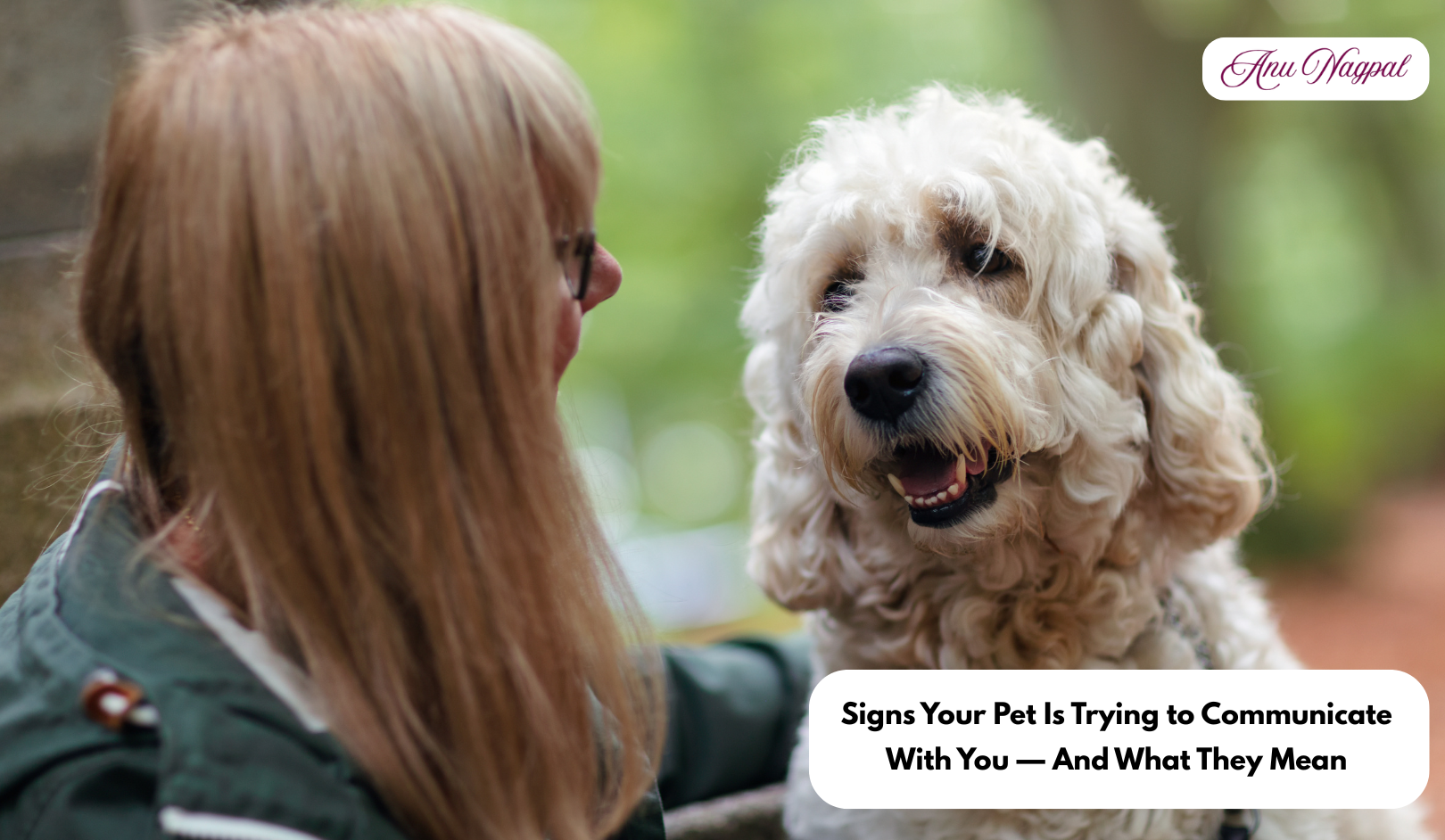
Signs Your Pet Is Trying to Communicate With You — And What They Mean
Every pet — whether a dog, cat, rabbit, bird, or even a rescued animal — constantly communicates with its human. Unfortunately, many of these messages go unheard simply because pet parents don’t know how to interpret the signs.
As one of the best animal communicators in Delhi, I, Anu Nagpal, have witnessed thousands of pets express their needs, fears, joys, and health concerns in subtle yet powerful ways. When these messages are understood early, pets become happier, calmer, healthier, and more connected with their families.
🌟 Understanding How Pets Communicate: The Silent Language of Emotion
Pets do not rely only on physical gestures; they use:
-
Energy vibrations
-
Telepathic impressions
-
Behavioral shifts
-
Body language
-
Eye contact
-
Environmental responses
-
Dream-state signals
Their communication is pure and direct, without filters or manipulation. When you begin to recognize these cues, your relationship moves from “owner and pet” to “souls in connection.”
Let’s decode the signs your pet is sending you — every single day.
🐾 1. Sudden Changes in Behavior — A Direct Message You Must Not Ignore
Behavioral change is one of the strongest messages animals use.
If your pet:
-
Becomes unusually quiet
-
Acts hyperactive
-
Avoids you or hides
-
Shows aggression without reason
-
Appears clingier than usual
…it means something is happening internally.
What This Communication Means
💬 “I am uncomfortable — physically or emotionally.”
💬 “Something has changed in my environment.”
💬 “I need your attention right now.”
Common causes:
-
Health issues
-
Emotional stress
-
Fear
-
Energetic sensitivity
-
Changes in household dynamics
-
Someone’s negative emotions affecting them
Animals are energy sponges — they pick up vibes faster than humans.
🐾 2. Intense Eye Contact — They Are Sending You a Thought
When your pet locks eyes with you for long moments, they are connecting telepathically.
This type of communication may mean:
-
Love and bonding
-
Asking for reassurance
-
Request for food, walk, or attention
-
Trying to tell you something important
-
Emotional depth that words cannot capture
Many pets also send images or feelings during eye contact.
As an animal communicator, I often help pet parents understand these messages.
Look for:
-
Soft, blinking eyes → Love, trust, relaxation
-
Wide, focused eyes → They want to say something urgent
🐾 3. Tail, Ear & Body Posture Changes — A Strong Language of Expression
Animals have an entire vocabulary through posture.
A raised tail = Excitement or curiosity
A tucked tail = Fear or insecurity
Ears forward = Alert or asking a question
Ears flat = Stress, pain, or discomfort
These signals often relate to:
-
A person entering the home
-
Changes in environment
-
Another pet’s energy
-
Emotional conflict within the home
-
Desire to go out or explore
Learning this language strengthens trust profoundly.
🐾 4. Pawing, Nudging & Physical Touch — Messages of Need
If your pet:
-
Paws at you
-
Nudges your hand
-
Places their head on your lap
-
Sits on your feet
-
Brushes against your legs
They are expressing something very clear.
Meaning Behind These Actions
💬 “Please notice me.”
💬 “I want affection.”
💬 “I am anxious; stay close.”
💬 “Something is bothering me.”
💬 “I sense your stress — let me help you.”
Yes, pets often try to heal your energy.
Many pets act like emotional healers for their humans.
🐾 5. Vocal Cues — Different Sounds Mean Different Emotions
Pets vocalize strategically:
-
Soft whines → Seeking attention or expressing discomfort
-
Loud barking/meowing → Alerting you to something wrong
-
Howling → Loneliness, sadness, or energy sensitivity
-
Purring (cats) → Comfort, healing, or bonding
Each sound carries emotional frequency.
If your pet is unusually vocal:
They are trying to communicate something specific — not simply making noise.
🐾 6. Following You Everywhere — An Emotional Signal
If your pet shadows you constantly, it means:
-
They feel deeply bonded
-
They sense your stress or sadness
-
They fear being alone
-
They are worried about something
-
They want reassurance
-
They have a message and need attention
Some pets also take on their human’s emotional burden.
This is why animal communication helps restore balance.
🐾 7. Avoiding You Suddenly — Silent Cry for Help
A normally affectionate pet who suddenly avoids you is telling you:
💬 “I am hurting.”
💬 “I feel unsafe or confused.”
💬 “My energy is disturbed.”
This is often linked to:
-
Illness
-
Emotional trauma
-
Change in routine
-
Conflict with another pet
-
Environmental stress
🐾 8. Bringing You Objects — Symbolic Messages You Must Decode
Pets communicate symbolically too.
If they bring you:
-
A toy → They want play or attention
-
A slipper/clothing → They want comfort or closeness
-
Random household items → They are trying to show something affecting them
Dogs and cats often express their emotions by choosing objects that hold your scent.
🐾 9. Changes in Eating or Sleeping Habits — Energetic or Emotional Signals
Sudden appetite changes often indicate:
-
Physical pain
-
Emotional anxiety
-
Environmental energy shifts
-
Nutritional imbalance
Change in sleep patterns may mean:
-
They are guarding you
-
Feeling restless
-
Feeling unsafe
-
Energetic disturbances at home
-
Emotional discomfort
Pets sense energies in the home far more deeply than humans.
🐾 10. Staring Into Corners or Empty Spaces — Highly Sensitive Behavior
Many pets see and sense:
-
Subtle energies
-
Spirits
-
Emotional vibrations
-
Shifts in environment
-
Electrical or atmospheric changes
If your pet stares at a particular spot often, they are responding to unseen energy patterns.
🐾 11. Mirroring Your Emotions — Deep Soul Connection
One of the strongest signs of communication is when pets reflect your emotional state.
If you are:
-
Sad → they appear quiet
-
Angry → they get nervous
-
Excited → they become playful
-
Stressed → they act clingy
Pets often take on emotional energy to support you.
🌼 How Animal Communication Helps Decode These Signs
As the best animal communicator in Delhi, my role is to bridge the gap between what your pet feels and what you understand.
Through intuitive communication, telepathy, and energy connection, we can:
-
Identify health concerns early
-
Understand emotional struggles
-
Resolve behavioral issues
-
Heal past trauma
-
Strengthen the human–animal bond
-
Support pets during transitions
-
Help rescue pets express their stories
-
Provide guidance during illness or end-of-life
Many pet parents experience breakthroughs within the very first session.
🌟 Real Transformations When You Listen to Your Pet
When a pet feels understood:
-
Anxiety reduces
-
Aggression disappears
-
Trust deepens
-
Clarity increases
-
Healing begins
-
Behavior becomes calm
-
Emotional balance returns
Your pet does not want luxury —
It wants connection, safety, clarity, and love.
Animal communication gives them a voice they always had, but could never express verbally.
🐾 How You Can Start Understanding Your Pet Better
Here are simple steps to improve communication at home:
✔ Observe their body language
✔ Maintain emotional stability around them
✔ Follow a consistent routine
✔ Make eye contact and stay present
✔ Speak calmly — tone matters
✔ Note sudden changes in behavior
✔ Give them safe space when needed
✔ Get professional communication sessions for clarity
When you learn to listen, your pet becomes an open book.
✨ Final Thoughts: Your Pet Is Always Speaking — Are You Listening?
Every gesture, blink, paw, bark, or silence is a message.
Pets are deeply sensitive souls.
They understand love without words —
And they communicate back with silent, powerful signs.
If you learn to decode these signs, your relationship transforms into a sacred bond.
As Delhi’s best animal communicator, I help pet parents truly understand what their animal companions are trying to say — their needs, fears, joys, and unspoken stories.
Your pet has a voice.
Together, let’s help you hear it.
❓ FAQs About Animal Communication
1. What is animal communication?
Animal communication is the intuitive, telepathic, and energetic exchange between pets and humans, helping reveal their emotions, needs, and health concerns.
2. How do I know if my pet is trying to tell me something?
Watch for sudden behavior changes, unusual vocalizations, eye contact, clinginess, avoidance, or unexplained actions. These indicate a deeper message.
3. Can animal communication help with behavioral issues?
Yes. Issues like aggression, anxiety, separation fear, and destructive behavior often improve once we understand the emotional cause.
4. Does animal communication work for older pets?
Absolutely. Senior pets communicate their pain levels, comfort needs, and emotional states very clearly during sessions.
5. Can I communicate with my pet myself?
Yes, with practice, meditation, and awareness. But a professional communicator helps decode messages more accurately.